

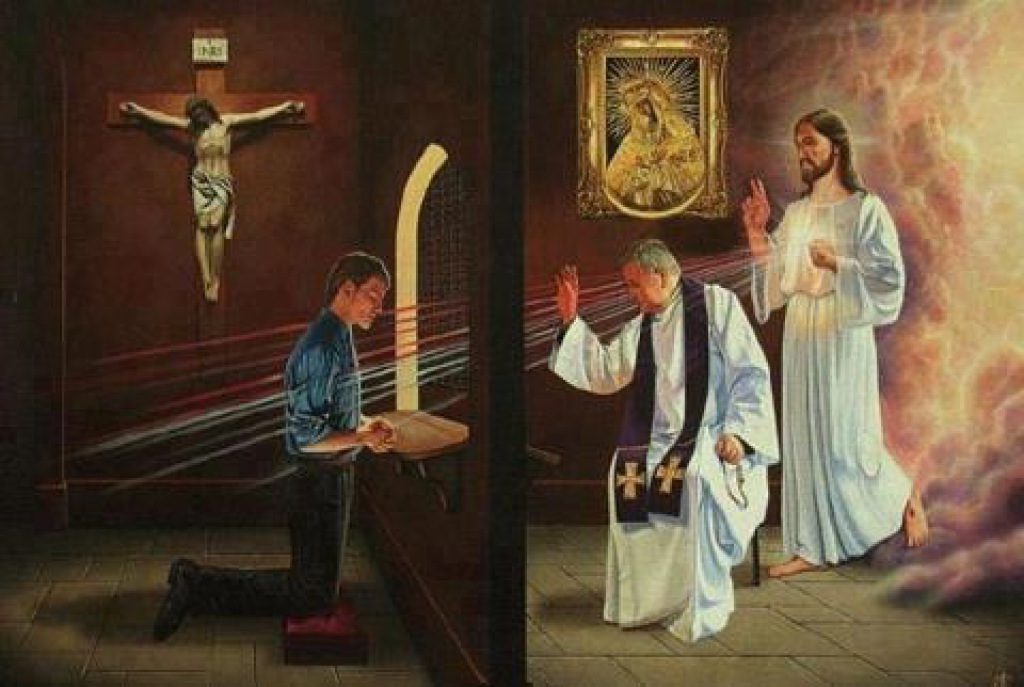
The issue of “confession” or “The Sacrament of Reconciliation” is a focus of much scrutiny from non-catholics, and even some catholics. Often, in regards to the topic one may question: “Why do I have to confess to a priest? Why can’t I just go to God?” – “Why must I confess at all? God knows I know I have made a mistake and want to fix it. If he knows already, why should I even bother?” – “I thought the church was just 2-3 believers praying together. Why do I need a human authority?”
Scripture itself addresses all these issues. In this article, I will provide Scriptural evidence for the practice of Confession, specifically to a priest, or at the very least in some public manner to fellow Christians. Also, I will provide early Christian writings which support this particular reading of scripture.
It is important to keep in mind that the Catholic Church does not submit to the Protestant doctrine of “Sola Scriptura” or “Scripture Alone”. This means that Scripture is not the ONLY authority in the Catholic church, and is not the ONLY way one can formulate truth. It is however, typically understood as the ULTIMATE Authority, so still holds much weight when it comes to determining Doctrine(Truth claim) on Faith and Morals. 2 Thessalonians 2:15:”15 Therefore, brethren, stand fast, and hold the traditions which ye have been taught, whether by word, or our epistle.”
When arguing for or against a stance, it is important to first understand what exactly is being claimed. Lets first establish what “The Church” teaches on thie topic of “Confession” and it’s own Authority. Below is a Summarized version of the following writings found in the links attached.
The Sacrament of Confession(Penance/Reconciliation)
CCC 1422-1498: https://www.williamhamant.com/wp-content/uploads/2023/02/CCC-1422-1498-1846-1876-Sacrament-of-Penance.pdf
1422 “Those who approach the sacrament of Penance obtain pardon from God’s mercy for the offense committed against him, and are, at the same time, reconciled with the Church which they have wounded by their sins…1440 Sin is before all else an offense against God, a rupture of communion with him. At the same time it damages communion with the Church. For this reason conversion entails both God’s forgiveness and reconciliation with the Church, which are expressed and accomplished liturgically by the sacrament of Penance and Reconciliation…1441 Only God forgives sins.39 Since he is the Son of God, Jesus says of himself, “The Son of man has authority on earth to forgive sins” and exercises this divine power: “Your sins are forgiven.”40 Further, by virtue of his divine authority he gives this power to men to exercise in his name….1444 In imparting to his apostles his own power to forgive sins the Lord also gives them the authority to reconcile sinners with the Church. This ecclesial dimension of their task is expressed most notably in Christ’s solemn words to Simon Peter: “I will give you the keys of the kingdom of heaven, and whatever you bind on earth shall be bound in heaven, and whatever you loose on earth shall be loosed in heaven.”45 “The office of binding and loosing which was given to Peter was also assigned to the college of the apostles united to its head.”…1456 Confession to a priest is an essential part of the sacrament of Penance: “All mortal sins of which penitents after a diligent self-examination are conscious must be recounted by them in confession, even if they are most secret and have been committed against the last two precepts of the Decalogue; for these sins sometimes wound the soul more grievously and are more dangerous than those which are committed openly.”…1461 Since Christ entrusted to his apostles the ministry of reconciliation,65 bishops who are their successors, and priests, the bishops’ collaborators, continue to exercise this ministry. Indeed bishops and priests, by virtue of the sacrament of Holy Orders, have the power to forgive all sins “in the name of the Father, and of the Son, and of the Holy Spirit.”
The Authority of the Church
CCC 871-896: https://www.catholiccrossreference.online/catechism/#!/search/871-896
“Christ is himself the source of ministry in the Church. He instituted the Church. He gave her authority and mission, orientation and goal…The one sent by the Lord does not speak and act on his own authority, but by virtue of Christ’s authority; not as a member of the community, but speaking to it in the name of Christ. No one can bestow grace on himself; it must be given and offered. This fact presupposes ministers of grace, authorized and empowered by Christ. From him, bishops and priests receive the mission and faculty (“the sacred power”) to act in persona Christi Capitis; deacons receive the strength to serve the people of God in the diaconia of liturgy, word and charity, in communion with the bishop and his presbyterate. The ministry in which Christ’s emissaries do and give by God’s grace what they cannot do and give by their own powers, is called a “sacrament” by the Church’s tradition. Indeed, the ministry of the Church is conferred by a special sacrament….880 When Christ instituted the Twelve, “he constituted [them] in the form of a college or permanent assembly, at the head of which he placed Peter, chosen from among them.”398 Just as “by the Lord’s institution, St. Peter and the rest of the apostles constitute a single apostolic college, so in like fashion the Roman Pontiff, Peter’s successor, and the bishops, the successors of the apostles, are related with and united to one another.”…882 The Pope, Bishop of Rome and Peter’s successor, “is the perpetual and visible source and foundation of the unity both of the bishops and of the whole company of the faithful.”402 “For the Roman Pontiff, by reason of his office as Vicar of Christ, and as pastor of the entire Church has full, supreme, and universal power over the whole Church, a power which he can always exercise unhindered.”403…886 “The individual bishops are the visible source and foundation of unity in their own particular Churches.”408 As such, they “exercise their pastoral office over the portion of the People of God assigned to them,”409 assisted by priests and deacons. But, as a member of the episcopal college, each bishop shares in the concern for all the Churches.410 The bishops exercise this care first “by ruling well their own Churches as portions of the universal Church,” and so contributing “to the welfare of the whole Mystical Body, which, from another point of view, is a corporate body of Churches.”411 They extend it especially to the poor,412 to those persecuted for the faith, as well as to missionaries who are working throughout the world….893 The bishop is “the steward of the grace of the supreme priesthood,”423 especially in the Eucharist which he offers personally or whose offering he assures through the priests, his co-workers. The Eucharist is the center of the life of the particular Church. The bishop and priests sanctify the Church by their prayer and work, by their ministry of the word and of the sacraments. They sanctify her by their example, “not as domineering over those in your charge but being examples to the flock.”424 Thus, “together with the flock entrusted to them, they may attain to eternal life.”425”
Now, I will provide various text of scripture and early Christian Writing which is evidence of the Catholic claim about the “Sacrament” that is Confession (Reconciliation)
Confession of Sin
-Proverbs 28:13: “Whoever conceals their sins does not prosper, but the one who confesses and renounces them finds mercy.”
–1John 1:9: “ 9 If we confess our sins, he is faithful and just and will forgive us our sins and purify us from all unrighteousness.”
–Luke 15:18-21: The Prodigal Son: “18 I will set out and go back to my father and say to him: Father, I have sinned against heaven and against you. 19 I am no longer worthy to be called your son; make me like one of your hired servants.’ 20 So he got up and went to his father.“But while he was still a long way off, his father saw him and was filled with compassion for him; he ran to his son, threw his arms around him and kissed him.21 “The son said to him, ‘Father, I have sinned against heaven and against you. I am no longer worthy to be called your son.”
The Didache(AD70-110) Chapter 14:https://www.newadvent.org/fathers/0714.htm “But every Lord’s day gather yourselves together, and break bread, and give thanksgiving after having confessed your transgressions, that your sacrifice may be pure. But let no one that is at variance with his fellow come together with you, until they be reconciled, that your sacrifice may not be profaned. For this is that which was spoken by the Lord: In every place and time offer to me a pure sacrifice; for I am a great King, says the Lord, and my name is wonderful among the nations.”(1 Corinthians 11:26-29)
Public Confession of Sin
-James 5:16: “16 Therefore confess your sins to each other and pray for each other so that you may be healed. The prayer of a righteous person is powerful and effective.”
-Acts 19:17-19 “17 When this became known to the Jews and Greeks living in Ephesus, they were all seized with fear, and the name of the Lord Jesus was held in high honor. 18 Many of those who believed now came and openly confessed what they had done. 19 A number who had practiced sorcery brought their scrolls together and burned them publicly. When they calculated the value of the scrolls, the total came to fifty thousand drachmas.”
Tertullian:(AD 160-240)On Repentance:https://www.newadvent.org/fathers/0320.htm “This act, which is more usually expressed and commonly spoken of under a Greek name, is ἐξομολόγησις, whereby we confess our sins to the Lord, not indeed as if He were ignorant of them, but inasmuch as by confession satisfaction is settled, of confession repentance is born; by repentance God is appeased. And thus exomologesis is a discipline for man’s prostration and humiliation, enjoining a demeanor calculated to move mercy. With regard also to the very dress and food, it commands (the penitent) to lie in sackcloth and ashes, to cover his body in mourning, to lay his spirit low in sorrows, to exchange for severe treatment the sins which he has committed; moreover, to know no food and drink but such as is plain — not for the stomach’s sake, to wit, but the soul’s; for the most part, however, to feed prayers on fastings, to groan, to weep and make outcries unto the Lord your God; to bow before the feet of the presbyters, and kneel to God’s dear ones; to enjoin on all the brethren to be ambassadors to bear his deprecatory supplication (before God). All this exomologesis (does), that it may enhance repentance; may honour God by its fear of the (incurred) danger; may, by itself pronouncing against the sinner, stand in the stead of God’s indignation, and by temporal mortification (I will not say frustrate, but) expunge eternal punishments. Therefore, while it abases the man, it raises him; while it covers him with squalor, it renders him more clean; while it accuses, it excuses; while it condemns, it absolves.” exomologesis: “a public confession of sin and the entire process of penance and reconciliation with the church”
Confession: An Old Testament Sacrament
It is important to note the way the Israelites first did things, as that is to be a model for Christian life. Paul in his letter to the Colossians notes that these things were “Shadows” to the new, meaning they were all designed to point to the same thing “The Paschal Lamb” Jesus, and His New Covenant.
-Numbers 5:6-7: 6 “Say to the Israelites: ‘Any man or woman who wrongs another in any way and so is unfaithful to the Lord is guilty 7 and must confess the sin they have committed. They must make full restitution for the wrong they have done, add a fifth of the value to it and give it all to the person they have wronged.”
-Leviticus 19:21-22: “21 The man, however, must bring a ram to the entrance to the tent of meeting for a guilt offering to the Lord. 22 With the ram of the guilt offering the priest is to make atonement for him before the Lord for the sin he has committed, and his sin will be forgiven.”
-Leviticus 5:5-6:”5: “when anyone becomes aware that they are guilty in any of these matters, they must confess in what way they have sinned. 6 As a penalty for the sin they have committed, they must bring to the Lord a female lamb or goat from the flock as a sin offering; and the priest shall make atonement for them for their sin.”
Authority given to the Apostles by Jesus (Sinners like you and me)
-Luke 10:16: “16 “Whoever listens to you listens to me; whoever rejects you rejects me; but whoever rejects me rejects him who sent me.”
-John 20:20-24:”20 After he said this, he showed them his hands and side. The disciples were overjoyed when they saw the Lord.21 Again Jesus said, “Peace be with you! As the Father has sent me, I am sending you.” 22 And with that he breathed on them and said, “Receive the Holy Spirit. 23 If you forgive anyone’s sins, their sins are forgiven; if you do not forgive them, they are not forgiven.”
-Matthew 16:18-19 & Isaiah 22:20-22:”Matthew:18 And I say also unto thee, That thou art Peter, and upon this rock I will build my church; and the gates of hell shall not prevail against it.19 And I will give unto thee the keys of the kingdom of heaven: and whatsoever thou shalt bind on earth shall be bound in heaven: and whatsoever thou shalt loose on earth shall be loosed in heaven….Isaiah:20 And it shall come to pass in that day, that I will call my servant Eliakim the son of Hilkiah:21 And I will clothe him with thy robe, and strengthen him with thy girdle, and I will commit thy government into his hand: and he shall be a father to the inhabitants of Jerusalem, and to the house of Judah.22 And the key of the house of David will I lay upon his shoulder; so he shall open, and none shall shut; and he shall shut, and none shall open.”
-John 21:15-17:”15 So when they had dined, Jesus saith to Simon Peter, Simon, son of Jonas, lovest thou me more than these? He saith unto him, Yea, Lord; thou knowest that I love thee. He saith unto him, Feed my lambs.16 He saith to him again the second time, Simon, son of Jonas, lovest thou me? He saith unto him, Yea, Lord; thou knowest that I love thee. He saith unto him, Feed my sheep.17 He saith unto him the third time, Simon, son of Jonas, lovest thou me? Peter was grieved because he said unto him the third time, Lovest thou me? And he said unto him, Lord, thou knowest all things; thou knowest that I love thee. Jesus saith unto him, Feed my sheep.”
Ministry of Reconciliation, and Mediation Between Man and God
2 Corinthians 5:18-21: “18 All this is from God, who reconciled us to himself through Christ and gave us the ministry of reconciliation: 19 that God was reconciling the world to himself in Christ, not counting people’s sins against them. And he has committed to us the message of reconciliation. 20 We are therefore Christ’s ambassadors, as though God were making his appeal through us. We implore you on Christ’s behalf: Be reconciled to God. 21 God made him who had no sin to be sin[b] for us, so that in him we might become the righteousness of God.”
-Acts 8:18-24:”22 Repent of this wickedness and pray to the Lord in the hope that he may forgive you for having such a thought in your heart. 23 For I see that you are full of bitterness and captive to sin.”24 Then Simon answered, “Pray to the Lord for me so that nothing you have said may happen to me.”
“The Church” as a Visible Unified, and Authoritative Body
Matthew 18:15-18″15 Moreover if thy brother shall trespass against thee, go and tell him his fault between thee and him alone: if he shall hear thee, thou hast gained thy brother.16 But if he will not hear thee, then take with thee one or two more, that in the mouth of two or three witnesses every word may be established.17 And if he shall neglect to hear them, tell it unto the church: but if he neglect to hear the church, let him be unto thee as an heathen man and a publican.18 Verily I say unto you, Whatsoever ye shall bind on earth shall be bound in heaven: and whatsoever ye shall loose on earth shall be loosed in heaven.”
Acts 15: Summarized: “22 Then pleased it the apostles and elders with the whole church, to send chosen men of their own company to Antioch with Paul and Barnabas; namely, Judas surnamed Barsabas and Silas, chief men among the brethren…25 It seemed good unto us, being assembled with one accord, to send chosen men unto you with our beloved Barnabas and Paul…35 Paul also and Barnabas continued in Antioch, teaching and preaching the word of the Lord, with many others also…40 And Paul chose Silas, and departed, being recommended by the brethren unto the grace of God.41 And he went through Syria and Cilicia, confirming the churches.”
1 Timothy 3:15: “15 But if I tarry long, that thou mayest know how thou oughtest to behave thyself in the house of God, which is the church of the living God, the pillar and ground of the truth.“
Hebrews 13:12-18:”12 Wherefore Jesus also, that he might sanctify the people with his own blood, suffered without the gate.13 Let us go forth therefore unto him without the camp, bearing his reproach.14 For here have we no continuing city, but we seek one to come.15 By him therefore let us offer the sacrifice of praise to God continually, that is, the fruit of our lips giving thanks to his name.16 But to do good and to communicate forget not: for with such sacrifices God is well pleased.17 Obey them that have the rule over you, and submit yourselves: for they watch for your souls, as they that must give account, that they may do it with joy, and not with grief: for that is unprofitable for you.18 Pray for us: for we trust we have a good conscience, in all things willing to live honestly.
St. Ignatius of Antioch:Letter to the Philadelphians(Lived 50-110 AD), would have known of the Apostles personally“Keep yourselves from those evil plants which Jesus Christ does not tend, because they are not the planting of the Father. Not that I have found any division among you, but exceeding purity. For as many as are of God and of Jesus Christ are also with the bishop. And as many as shall, in the exercise of repentance, return into the unity of the Church, these, too, shall belong to God, that they may live according to Jesus Christ. Do not err, my brethren. If any man follows him that makes a schism in the Church, he shall not inherit the kingdom of God. If any one walks according to a strange opinion, he agrees not with the passion [of Christ.].”
St. Cyprian(Death 258 AD)On the Unity of the Church;On the Lapsed:https://www.newadvent.org/fathers/050701.htm “5. And this unity we ought firmly to hold and assert, especially those of us that are bishops who preside in the Church, that we may also prove the episcopate itself to be one and undivided…The Church also is one, which is spread abroad far and wide into a multitude by an increase of fruitfulness. As there are many rays of the sun, but one light; and many branches of a tree…6. The spouse of Christ cannot be adulterous; she is uncorrupted and pure. She knows one home; she guards with chaste modesty the sanctity of one couch. She keeps us for God. She appoints the sons whom she has born for the kingdom. Whoever is separated from the Church and is joined to an adulteress, is separated from the promises of the Church; nor can he who forsakes the Church of Christ attain to the rewards of Christ. He is a stranger; he is profane; he is an enemy…He who does not hold this unity does not hold God’s law, does not hold the faith of the Father and the Son, does not hold life and salvation…the souls of the righteous and of the unrighteous are already divided, and the chaff is separated from the wheat. These are they who of their own accord, without any divine arrangement, set themselves to preside among the daring strangers assembled, who appoint themselves prelates without any law of ordination, who assume to themselves the name of bishop, although no one gives them the episcopate…12. Nor let any deceive themselves by a futile interpretation, in respect of the Lord having said, Wheresoever two or three are gathered together in my name, there am I in the midst of them.
Matthew 18:20 Corrupters and false interpreters of the Gospel quote the last words, and lay aside the former ones, remembering part, and craftily suppressing part: as they themselves are separated from the Church, so they cut off the substance of one section. For the Lord, when He would urge unanimity and peace upon His disciples, said, I say unto you, That if two of you shall agree on earth touching anything that you shall ask, it shall be given you by my Father which is in heaven. For wheresoever two or three are gathered together in my name, I am with them;
showing that most is given, not to the multitude, but to the unanimity of those that pray.”
Church Leaders
1 Timothy 4:13-14:”13 Till I come, give attendance to reading, to exhortation, to doctrine.14 Neglect not the gift that is in thee, which was given thee by prophecy, with the laying on of the hands of the presbytery.“
Titus 1: Summarized: “4 To Titus, mine own son after the common faith: Grace, mercy, and peace, from God the Father and the Lord Jesus Christ our Saviour.5 For this cause left I thee in Crete, that thou shouldest set in order the things that are wanting, and ordain elders in every city, as I had appointed thee:6 If any be blameless, the husband of one wife, having faithful children not accused of riot or unruly.7 For a bishop must be blameless, as the steward of God; not selfwilled, not soon angry, not given to wine, no striker, not given to filthy lucre;8 But a lover of hospitality, a lover of good men, sober, just, holy, temperate;
The Didache(AD70-110): Chapter 15:https://www.newadvent.org/fathers/0714.htm “Therefore, appoint for yourselves bishops and deacons worthy of the Lord, men meek, and not lovers of money, 1 Timothy 3:4 and truthful and proven; for they also render to you the service of prophets and teachers. Despise them not therefore, for they are your honoured ones, together with the prophets and teachers. And reprove one another, not in anger, but in peace, as you have it in the Gospel; Matthew 18:15-17 but to every one that acts amiss against another, let no one speak, nor let him hear anything from you until he repents. But your prayers and alms and all your deeds so do, as you have it in the Gospel of our Lord.”
St. Clement of Rome, First Epistle https://www.newadvent.org/fathers/1010.htm(Written 70AD, knew Peter personally)Chapter 42″And thus preaching through countries and cities, they appointed the first fruits [of their labours], having first proved them by the Spirit, to be bishops and deacons of those who should afterwards believe. Nor was this any new thing, since indeed many ages before it was written concerning bishops and deacons. For thus says the Scripture in a certain place, I will appoint their bishops in righteousness, and their deacons in faith
.
St. Ignatius of Antioch(Letter to the Philadelphians(Lived 50-110 AD), would have known of the Apostles personally):”Take heed, then, to have but one Eucharist. For there is one flesh of our Lord Jesus Christ, and one cup to [show forth ] the unity of His blood; one altar; as there is one bishop, along with the presbytery and deacons, my fellow-servants: that so, whatsoever you do, you may do it according to [the will of] God.”
Reasoning
Hopefully, after reading this series of text it is clear to the reader that the Catholic system for Repentance, Confession, and Reconciliation, is what best reflects that which is described in the Bible itself. However, if there is any confusion still, we can go through it again in more plain language.
What The Church Teaches: Essentially, the teaching of the Church is that Jesus whom is God and has the Authority to forgive sins, gave that Authority to his Apostles. It is important to keep in mind, the Apostles were sinners with normal lives, and normal backgrounds. They were chosen by God,yes – but so are we. Jesus clearly in scripture gave them that Authority through Him, in His name. Through those men, Jesus Created a “Church”, of which he appointed them as leaders, seemingly Peter in particular has special significance. He gave them teaching Authority and treated them as though they were Him. Those same apostles appointed successors, which through that appointment were given that same Authority. When one “confesses his sin” to a priest, it is not of the Priests Authority, it is that of Jesus. In His name, they have the authority to forgive a man of his sins.
Scripture and Early Christian Writing
Confession as a general practice is clearly displayed as something which must be done if one wants to be forgiven. The question is to whom, and by what authority. Most will agree that confession must at least be done to God. (Though how many of us do this regularly? Are we specific, or do we just say vague sins like lust, pride, etc?)
We see through Scripture, that public confession of some fashion is important and must be done. This is done at the Catholic Mass as a unified body “I confess to almighty God,and to you, my brothers and sisters, that I have greatly sinned through my thoughts and in my words,in what I have done, and in what I have failed to do;through my fault, through my fault,through my most grievous fault; therefore I ask blessed Mary ever-Virgin,all the Angels and Saints,and you, my brothers and sister,to pray for me to the Lord our God.”
We then see, that in the Old Testament Sacrificial system, when an Israelite sinned, they were required to confess their sin, and bring an offering. That offering was brought to the priest, whom “Made atonement for him” for their sin, and their sin was forgiven. This shows a Priestly Authority from God in the Old Testament system, which is a reflection of Christianity. A man confesses his sin, the Paschal Lamb(The Eucharist, the Body and Blood of Jesus) is presented as a sacrifice for that man by the Priest, and the man is forgiven. God set up the system, gave the priests authority, and through that priest, the man was forgiven.
Then, Authority from God is given to the Apostles. “If you forgive anyone’s sins, their sins are forgiven; if you do not forgive them, they are not forgiven.” – These men were given the authority to forgive the sins of others in their charge. These were the first “Pastors” of the Church whom were given flocks to take care of and guide to salvation. Peter specifically is called out to “Feed my sheep”.
In the writing of Paul in Corinthians and Luke in Acts, we are told of a “Ministry(message) of Reconciliation” of which has been put into place by the “ambassadors of Christ”. In addition, we are introduced to the idea of “Intercession” of which a person asks to be prayed for on another’s behalf.
Then, a clear Church structure which has ranks, leaders, and parameters of which it is run. If there is an issue between you and a “brother”, and you are unable to sort it out with the help of others, you are to bring it to “the church”, which depending on the situation may exclude him from the Church. This on its own suggests an Authoritative body which can make these judgements with the authority required to do so. Unity to one particular body of believers is clearly what was understood by the early Christians, and issues of faith are decided by coming together in “one accord” with the assistance of the Holy Spirit. – Then, a clear Hierarchical structure within the church: Bishops-Presbyters(Minister)-Deacons-Elders
All this to be said, it seems clear to me that there is one particular body of Christians that Jesus intended to be unified under one baptism, one confession of faith, and one authority. And through that authority, the confession of sin to a priest is Biblical, and most beneficial to the sanctification and Salvation of a member of the Church.
Attached is a series of different sources which may assist the reader in learning more if they are not convinced by my analysis, or just want more options on different topics. Also attached are other articles I have written on similar topics.
Web Links to Writings and Article Hubs
https://www.catholic.com/ — https://www.newadvent.org/fathers/ — https://formed.org/individuals — https://www.scotthahn.com/catholic-theological-resources — https://www.wordonfire.org/resources/?_gl=1*1clzemf*_up*MQ..*_ga*MTg3MjQ1Mjc4OC4xNzYxNjg2ODI4*_ga_4081DYV3TL*czE3NjE2ODY4MjgkbzEkZzEkdDE3NjE2ODY4NDIkajQ2JGwwJGgw
Catholic Apologists and thinkers
https://www.youtube.com/TheCounselofTrent — https://www.youtube.com/@pintswithaquinas — https://www.youtube.com/@shamelesspopery — https://www.youtube.com/@BishopBarron —
Books
More of my Articles
https://baqash.org/2024/05/04/the-eucharist-is-it-really-jesus/ — https://baqash.org/2024/03/15/salvation-a-rework/ — https://baqash.org/2024/03/05/mary-the-perpetual-virgin-and-mother-of-god/ — https://baqash.org/2024/02/20/did-jesus-exist/ — https://baqash.org/2024/02/16/homosexuality-and-the-bible/ — https://baqash.org/2024/02/06/nothing-happens-when-i-pray-overcoming-your-lack-of-faith/
 Baqash : To Seek
Leave a comment