
This Article serves to provide sources from the early church, as well as scriptural basis for the idea of a Pope as presented by the Catholic Church.
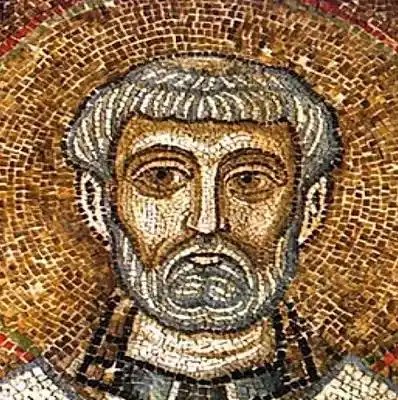
First Century
Clement of Rome : Mentioned in Philippians 4:3 : Letter to the Corinthians: “Let us, therefore, flee from the warning threats pronounced by Wisdom on the disobedient, and yield submission to His all-holy and glorious name, that we may stay our trust upon the most hallowed name of His majesty(Jesus)…If, however, any shall disobey the words spoken by Him through us, let them know that they will involve themselves in transgression and serious danger; but we shall be innocent of this sin, and, instant in prayer and supplication, shall desire that the Creator of all preserve unbroken the computed number of His elect in the whole world through His beloved Son Jesus Christ, through whom He called us from darkness to light”
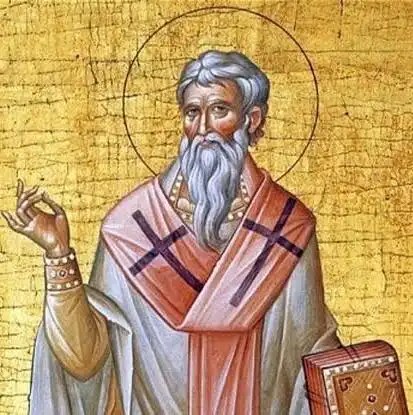
Second Century
Irenaeus of Lyons: Born in Smyrna : Wrote “Against Heresies” : Disciple of Polycarp who knew John
“Since, however, it would be very tedious, in such a volume as this, to reckon up the successions of all the Churches, we do put to confusion all those who, in whatever manner, whether by an evil self-pleasing, by vainglory, or by blindness and perverse opinion, assemble in unauthorized meetings; [we do this, I say,] by indicating that tradition derived from the apostles, of the very great, the very ancient, and universally known Church founded and organized at Rome by the two most glorious apostles, Peter and Paul; as also [by pointing out] the faith preached to men, which comes down to our time by means of the successions of the bishops. For it is a matter of necessity that every Church should agree with this Church, on account of its preeminent authority… The blessed apostles, then, having founded and built up the Church, committed into the hands of Linus the office of the episcopate. Of this Linus, Paul makes mention in the Epistles to Timothy. To him succeeded Anacletus; and after him, in the third place from the apostles, Clement was allotted the bishopric….The blessed apostles, then, having founded and built up the Church, committed into the hands of Linus the office of the episcopate. Of this Linus, Paul makes mention in the Epistles to Timothy”
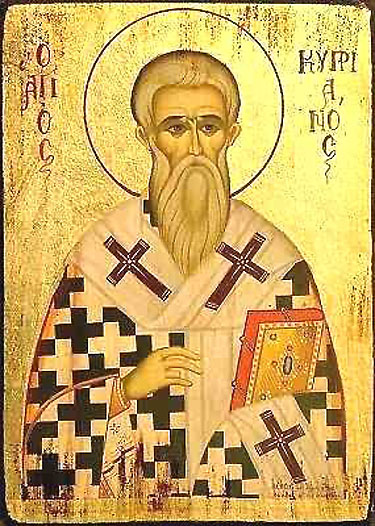
THIRD CENTURY
Cyprian of Carthage : Martyr : Wrote “On the Unity of the Church”: Christian convert at 46 with the help of Tertullian, another early Christian writer :
“The Lord speaks to Peter…And although to all the apostles, after His resurrection, He gives an equal power, and says, As the Father has sent me, even so send I you: Receive the Holy Ghost: Whose soever sins you remit, they shall be remitted unto him; and whose soever sins you retain, they shall be retained; John 20:21 …Does he who does not hold this unity of the Church think that he holds the faith? Does he who strives against and resists the Church trust that he is in the Church, when moreover the blessed Apostle Paul teaches the same thing, and sets forth the sacrament of unity, saying, There is one body and one spirit, one hope of your calling, one Lord, one faith, one baptism, one God? Ephesians 4:4…And this unity we ought firmly to hold and assert, especially those of us that are bishops who preside in the Church, that we may also prove the episcopate itself to be one and undivided. Let no one deceive the brotherhood by a falsehood: let no one corrupt the truth of the faith by perfidious prevarication. The episcopate is one, each part of which is held by each one for the whole. The Church also is one…This sacrament of unity, this bond of a concord inseparably cohering, is set forth where in the Gospel the coat of the Lord Jesus Christ is not at all divided nor cut, but is received as an entire garment, and is possessed as an uninjured and undivided robe by those who cast lots concerning Christ’s garment, who should rather put on Christ…Who, then, is so wicked and faithless, who is so insane with the madness of discord, that either he should believe that the unity of God can be divided, or should dare to rend it — the garment of the Lord — the Church of Christ? He Himself in His Gospel warns us, and teaches, saying, And there shall be one flock and one shepherd. John 10:16 And does any one believe that in one place there can be either many shepherds or many flocks?…”
FOURTH CENTURY
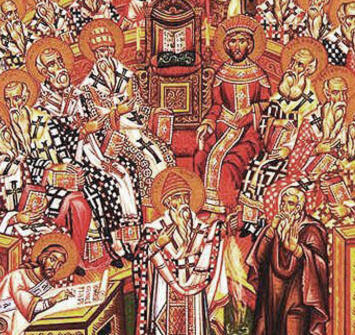
Council of Sardica AD 343: Dealt with issues between Bishops, and how to settle disputes between them
“But if judgment have gone against a bishop in any cause, and he think that he has a good case, in order that the question may be reopened, let us, if it be your pleasure, honour the memory of St. Peter the Apostle, and let those who tried the case write to Julius, the bishop of Rome, and if he shall judge that the case should be retried, let that be done, and let him appoint judges…||Bishop Gaudentius said: It ought to be added, if it be your pleasure, to this sentence full of sanctity which you have pronounced, that — when any bishop has been deposed by the judgment of those bishops who have sees in neighbouring places, and he [the bishop deposed] shall announce that his case is to be examined in the city of Rome— that no other bishop shall in any wise be ordained to his see, after the appeal of him who is apparently deposed, unless the case shall have been determined in the judgment of the Roman bishop….|| But if he who asks to have his case reheard, shall by his entreaty move the Bishop of Rome to send a presbyter a latere it shall be in the power of that bishop to do what he shall resolve and determine upon; and if he shall decide that some be sent, who shall be present and be judges with the bishops invested with his authority by whom they were appointed, it shall be as he shall choose.”
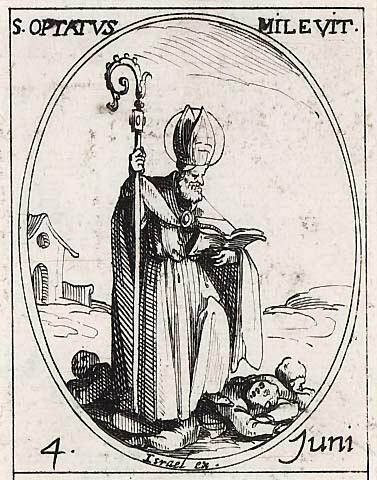
Optatus: Late 4th Century: Considered a saint in both Catholic and Orthodox traditions. Wrote on the Donatist Heresy. https://dn720203.ca.archive.org/0/items/theworkofstoptat00philuoft/theworkofstoptat00philuoft.pdf
“…lays it down that there is but one true Church of Christ, that she is not merely local, but is scattered Optatus, all over the world, her chief rulers bound together by formal bonds and proofs of union, each with his fellow, and above all with the Bishop of Rome, Peter’s successor…We may observe that from this time forward the Popes issued their decretal letters from a small council of Bishops.”
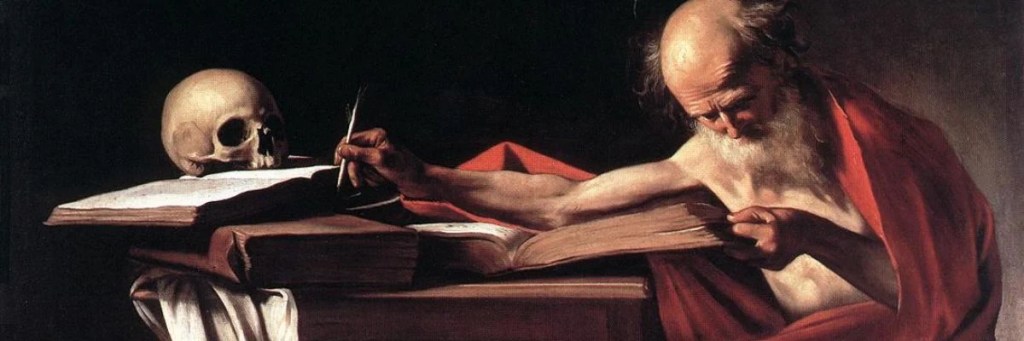
Jerome : Late 4th Century : Translated the Bible from its original languages to that of the people at the time, Latin : Wrote in Letter 15 to Pope Damasus asking for help dealing with a heresy:
“Since the East, shattered as it is by the long-standing feuds, subsisting between its peoples, is bit by bit tearing into shreds the seamless vest of the Lord, woven from the top throughout, John 19:23 since the foxes are destroying the vineyard of Christ, Song of Songs 2:15 and since among the broken cisterns that hold no water it is hard to discover the sealed fountain and the garden inclosed, Song of Songs 4:12 I think it my duty to consult the chair of Peter, and to turn to a church whose faith has been praised by Paul..Evil children have squandered their patrimony; you alone keep your heritage intact….As I follow no leader save Christ, so I communicate with none but your blessedness, that is with the chair of Peter. For this, I know, is the rock on which the church is built! Matthew 16:18 This is the house where alone the paschal lamb can be rightly eaten. Exodus 12:22 This is the Ark of Noah, and he who is not found in it shall perish when the flood prevails…. I implore your blessedness, therefore, by the crucified Saviour of the world, and by the consubstantial trinity…”
FIFTH CENTURY
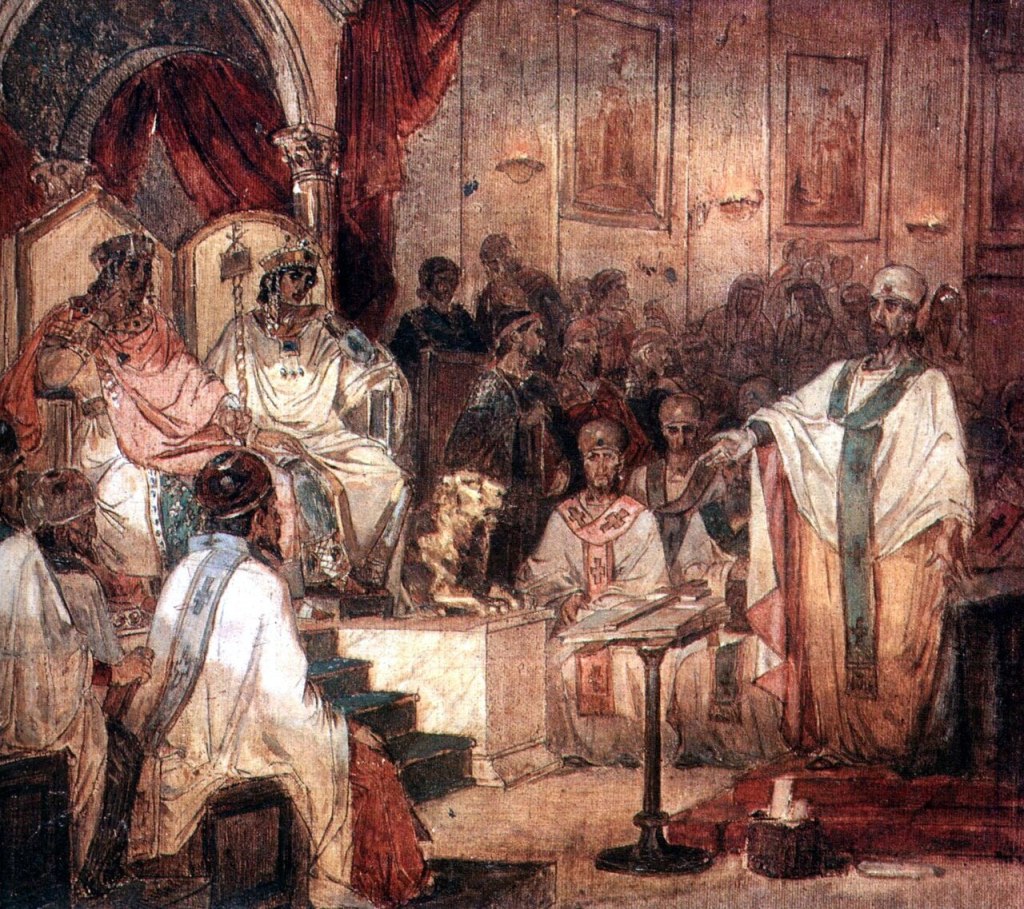
Council of Chalcedon: 451 AD : Dealt with issues concerning Christology, and condemning Nestorianism, a significant Heretical group of the time : Focuses on “Leo” the Bishop of Romes pronouncement against Nestorianism
“Florentius, the most reverend bishop of Sardis, said, since it is not possible for those who follow the teaching of the holy Synod of Nice, which was confirmed rightly and piously at Ephesus, to draw up suddenly a declaration of faith in accordance with the faith of the holy fathers Cyril and Celestine, and of the letter of the most holy Leo, we therefore pray your magnificence to give us time, so that we may be able to arrive at the truth of the matter with a fitting document, although so far as we are concerned, who have subscribed the letter of the most holy Leo, nothing further is needed…The faith has been well defined by the 318 holy fathers and confirmed by the holy fathers Athanasius, Cyril, Celestine, Hilary, Basil, Gregory, and now once again by the most holy Leo: and we pray that those things which were decreed by the 318 holy fathers, and by the most holy Leo be read…this is the true faith: this is the holy faith: this is the everlasting faith: into this we were baptized: into this we baptize: we all so believe: so believes Leo, the Pope (ὁ πάπας): Cyril thus believed: Pope Leo so interpreted it…The most glorious judges and the great senate said: Let there be read also the epistle of the most worthy Leo, Archbishop of Old Rome, the Imperial City…”
SIXTH CENTURY
Formula of Hormisdas: 519 AD : Letter and Agreements made across the churches after issues of Schism :
“The first condition of salvation is to keep the norm of the true faith and in no way to deviate from the established doctrine of the Fathers. For it is impossible that the words of our Lord Jesus Christ, who said, “Thou art Peter, and upon this rock I will build my Church,” [Matthew 16:18], should not be verified. And their truth has been proved by the course of history, for in the Apostolic See the Catholic religion has always been kept unsullied…Following, as we have said before, the Apostolic See in all things and proclaiming all its decisions, we endorse and approve all the letters which Pope St Leo wrote concerning the Christian religion. And so I hope I may deserve to be associated with you in the one communion which the Apostolic See proclaims, in which the whole, true, and perfect security of the Christian religion resides. I promise that from now on those who are separated from the communion of the Catholic Church, that is, who are not in agreement with the Apostolic See, will not have their names read during the sacred mysteries.”
SCRIPTURE – Visible Institution with Authority
Matthew 23:1-3 to Isaiah 21-22 and Matthew 16: Establishes the Typology of one
Matthew 18:17-18: Establishes a Church Authority, which can be identified and appealed to, which has the authority to “bind and loose”
John 20:21-23: Gives authority to the Apostles similar to that which the Father gave Him –
1 Timothy 3:15: Establishes a visible people who make up “The Church”, which is the Pillar of Truth
Psalm 69:20-26: to Acts 1:20-26: Showing that “The Church” has specific offices which can be “transferable” – Judas -> Matthias
SCRIPTURE – Definitions
1. Episcopacy / Bishop (episkopos): Acts 20:28“Take heed… to all the flock, in which the Holy Spirit has made you overseers (episkopous).” 1 Timothy 3:1-2: ““If anyone aspires to the office of overseer, he desires a noble task.” 1 Timothy Chapter 3 also outlines the details on how an “Overseer” must be chosen, and also how “Deacons” are to be chosen – This details a structured and organized process for leadership roles in the churches, which was established in this case by Paul
2. Presbyter / Elder (presbyteros): Acts 14:23: “They appointed elders (presbyterous) in every church.” Titus 1:5: ““Appoint elders in every town…” Titus 1 also details standards for Elders, and repeats some for the “overseers/episkopous”. Again is a case for a structured and organized system of leadership
3. Apostolic See: No clear scriptural reference to the term itself : Apostolic See is considered to be a church founded by an Apostle, which preserves it’s teachings: Directly after the baptizing of thousands in Jersualem Acts 2: ““And you will receive the gift of the Holy Spirit. 39 The promise is for you and your children and for all who are far off—for all whom the Lord our God will call…They devoted themselves to the apostles’ teaching… All the believers were together and had everything in common”
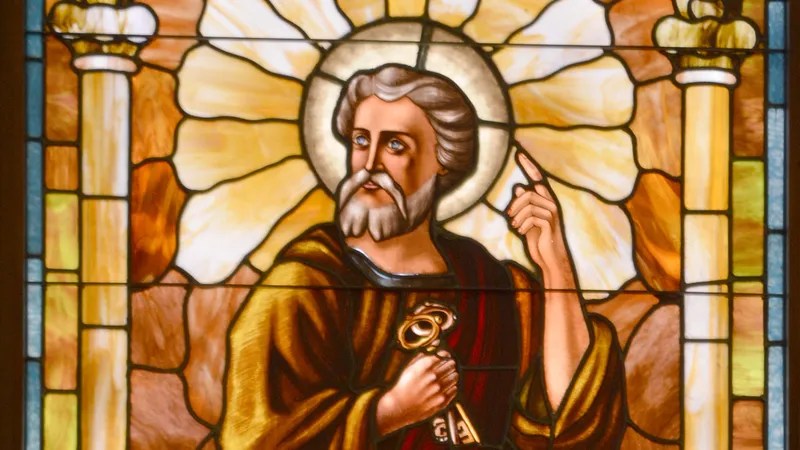
4. Peter the Pope (as a concept, not a title): The Bishop of Rome : Primary leader of the Churches, Authoritative Voice in disputes
Matthew 16:18-19: Keys are given only to Peter (As far as we can see in the text)
Luke 22: 32: Context: Last Supper – Jesus talking about what is about to happen to Him, and what the Apostles will do – “I have prayed for you that your faith may not fail; and when you have turned again, strengthen your brethren.”
John 21:15–17: Context: Jesus returned from the dead, meeting with the apostles, reprimanding Peter: Peter was hurt because Jesus asked him the third time, “Do you love me?” He said, “Lord, you know all things; you know that I love you.” Jesus said, “Feed my sheep.”
Peter in the New Testament assumes a leadership role amongst the Apostles, and is singled out by Jesus so that his faith does not fail, can strengthen his brethren, is given the keys to the kingdom, and seems to be enacted into a Pastoral role over the flock of Jesus.
 Baqash : To Seek
Leave a comment