
Often is the claim made from primarily Anti-Catholic folks, that at the Catholic Mass, Jesus is re-sacrificed. Meaning, Jesus is killed again, over and over. This understandably, if true, would be emotionally stirring and deeply disturbing. Scripture itself says in 1 Peter 3:18:“18 For Christ also suffered for sins once for all time, the just for the unjust, so that He might bring us to God, having been put to death in the flesh, but made alive in the spirit” – If the Church was re-sacrificing Jesus, it would be in contradiction with this passage of Scripture which says “Once for all”
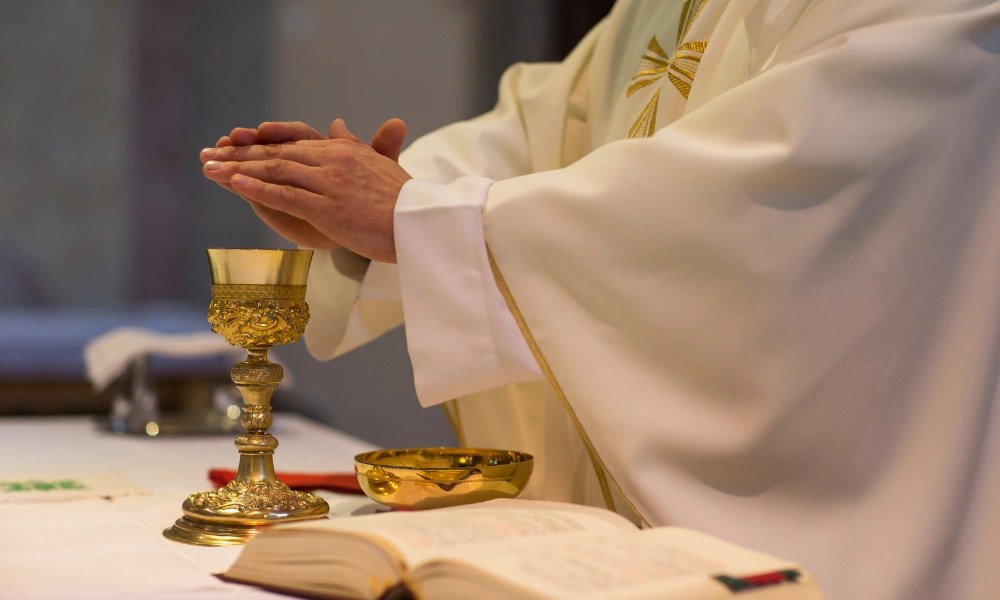
In this article I will show how this claim is not accurate to Catholic Teaching throughout the ages. In fact I will argue that the Mass Re-Presents the sacrifice one sacrifice of Christ on the cross. It is a portal through time to the one sacrifice, bringing it to our time and place. Christ is not killed over and over, but those who participate in the Mass are put face to face with the one Sacrifice of Christ, and He is offered to the father as our Paschal lamb.
I will start first Official Teaching, and bolster that teaching with Christian writers throughout the last 2000 years. This is a long list of sources and ideally will squash any belief that the Church has ever taught that Christ is re-sacrificed at the mass. If this does not cover it however, there are plenty more sources which can be presented.
CCC 1367: “The sacrifice of Christ and the sacrifice of the Eucharist are one single sacrifice: “The victim is one and the same: the same now offers through the ministry of priests, who then offered himself on the cross; only the manner of offering is different.” “And since in this divine sacrifice which is celebrated in the Mass, the same Christ who offered himself once in a bloody manner on the altar of the cross is contained and is offered in an unbloody manner… this sacrifice is truly propitiatory.”(Catechism Quoting the Council of Trent)
Council of Trent: 22nd Session: “For the victim is one and the same, the same now offering by the ministry of priests, who then offered Himself on the cross, the manner alone of offering being different. The fruits indeed of which oblation, of that bloody one to wit, are received most plentifully through this unbloody one; so far is this (latter) from derogating in any way from that (former oblation). Wherefore, not only for the sins, punishments, satisfactions, and other necessities of the faithful who are living, but also for those who are departed in Christ, and who are not as yet fully purified, is it rightly offered, agreebly to a tradition of the apostles.”…why Christ instituted the Mass at the Last Supper:to the end that He might leave to His own beloved spouse the Church, a visible sacrifice, such as the nature of men requires, whereby that bloody sacrifice, once to be accomplished on the cross, might be represented, and the memory thereof remain even unto the end of the world, and its salutary virtue be applied unto the remission of those sins which we daily commit.”
LUMEN GENTIUM §3 (Vatican II): “As often as the sacrifice of the cross in which Christ our Passover was sacrificed, is celebrated on the altar, the work of our redemption is carried on, and, in the sacrament of the eucharistic bread, the unity of all believers who form one body in Christ (8) is both expressed and brought about. All men are called to this union with Christ, who is the light of the world, from whom we go forth, through whom we live, and toward whom our whole life strains.“
The Catholic Encyclopedia: Summarized: It is the express teaching of the Church (cf. Trent, Sess. XXII, i) that the Mass is in its very nature a “representation” (representatio), a “commemoration” (memoria), and an “application” (applicatio) of the Sacrifice of the Cross.
Ignatius of Antioch(102 AD) “Take heed, then, to have but one Eucharist. For there is one flesh of our Lord Jesus Christ, and one cup to [show forth ] the unity of His blood; one altar; as there is one bishop, along with the presbytery and deacons, my fellow-servants: that so, whatsoever you do, you may do it according to [the will of] God.”
St. John Chrysostom(Died 407 AD): “On this account He ordained offerings continually,
because of their want of power, and that a remembrance of sins might be made. What then? Do not we offer every day? We offer indeed, but making a remembrance of His death, and this [remembrance] is one and not many.Inasmuch as that [Sacrifice] was once for all offered, [and] carried into the Holy of Holies. This is a figure of that [sacrifice] and this remembrance of that. For we always offer the same, not one sheep now and tomorrow another, but always the same thing: so that the sacrifice is one.This sacrifice (he says) is one; whereas the others were many: therefore they had no strength, because they were many….”
St. Augustine of Hippo (5th Century): “Was not Christ once for all offered up in His own person as a sacrifice? And yet, is He not likewise offered up in the sacrament as a sacrifice, not only in the special solemnities of Easter, but also daily among our congregations…”
ST. IRENAEUS OF LYONS (c. A.D. 189):”By these words he makes it plain that the former people will cease to make offerings to God; but that in every place sacrifice will be offered to him, and indeed, a pure one, for his name is glorified among the Gentiles.” (Against Heresies 4:17:5, A.D. 189)
ST. THOMAS AQUINAS (1225–1274), Summa Theologiae:”“There is but one victim, namely, that which Christ offered, and which we offer.” (Summa Theologiae III, 83)…“The sacrifices of the Old Law contained only in figure that true sacrifice of Christ’s Passion, whereas it was necessary that the sacrifice of the New Law instituted by Christ should have something more, namely, that it should contain Christ himself crucified, not merely in signification or figure, but also in very truth.” (Summa Theologiae III, 75)
ST. THOMAS AQUINAS, Lauda Sion (Sequence for Corpus Christi, 1264)A liturgical hymn composed by Aquinas himself for the Feast of Corpus Christi, commissioned by Pope Urban IV.– https://sspx.org/en/news/lauda-sion-salvatorem-corpus-christi-sequence-5159
DR. BRANT PITRE (Catholic Productions)“The error of Luther’s argument — that to call the Mass a sacrifice is blasphemy — is that he assumes the Mass and Calvary are two different sacrifices, that there was this one sacrifice on Calvary and that the Mass is another sacrifice that somehow has to add to the sacrifice at Calvary. But what Trent and the Catechism respond to that error by saying is: you misunderstand it. There’s only one sacrifice, and that’s the sacrifice of Jesus Christ. That one sacrifice of Christ on Calvary is made present in a different mode in the unbloody sacrifice of the Mass.“
WORD ON FIRE (Bishop Robert Barron)““Re-presenting doesn’t mean repeating, reproducing, or redoing. The sacrifice is not being double-checked, dittoed, or duplicated to ensure completeness. On the Catholic view, it’s already complete.”…“To re-present is to make present — to manifest an eternal reality here and now.”…”Since Jesus is divine, all of his actions, including and especially the sacrificial act by which he saved the world, participate in the eternity of God and hence can be made present at any point in time.” The Catholic Church teaches that this is precisely what the Mass does: makes present, from eternity, the once-for-all sacrifice of Christ on Calvary.”
CATHOLIC ANSWERS (Trent Horn):“The Catholic doctrine of the eucharistic sacrifice would contradict biblical teaching if it entailed a re-crucifixion of Jesus — but that’s not the case. The eucharistic sacrifice is not another sacrifice of Christ, as if Christ were repeatedly shedding his blood and dying. His bloody offering on the cross was a one-time event in the past and is never to be repeated. The offering in the eucharistic celebration re-presents — without blood, without making Jesus suffer and die anew — that one historical sacrifice….“Christ’s heavenly intercession, therefore, must consist of re-presenting to the Father his single sacrifice on the cross as a memorial offering and asking the Father to save those who draw near to him on account of that sacrifice.“
CATHOLIC ANSWERS MAGAZINE, “Once for All”: The Mass “has always been held to be a relative sacrifice — relative to the sacrifice of the Cross, not independent of it.” The Council of Trent says the Mass is the means “whereby that bloody sacrifice once to be accomplished on the Cross might be represented, the memory thereof remain even to the end of the world, and its salutary effects applied.”
Conclusion
We see then very clearly that it is, and has been throughout Catholic history, a myth that Christ is “re-sacrificed” or “killed over and over again” in the Mass. The truth of the matter is that the Church has always taught that the Mass is a Re-presentation of the one sacrifice of Jesus Christ, and that the one sacrifice of Christ is made present in our time for the forgiveness of sin.
To state otherwise, would be a lie. To ignore these sources, being Official teaching, Saints, and current day scholars, would be to willfully reject the reality of the matter.
Council of Trent: https://www.papalencyclicals.net/councils/trent/twenty-second-session.htm
Catechism of the Catholic Church: https://www.vatican.va/archive/ENG0015/_INDEX.HTM


Leave a comment